
This is general information about the Swiss framework, not legal advice, and your own position depends on the authorisation you hold. Where it matters, check with Swissmedic, the Federal Office of Public Health, the Federal Office for Agriculture or your cantonal office before you act.
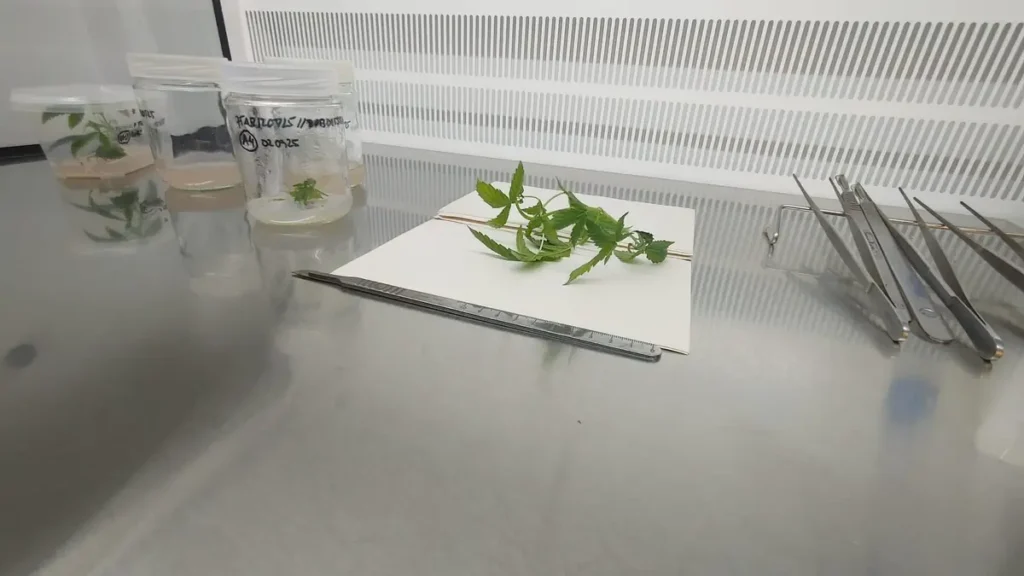
There is one feature of Swiss law that surprises nearly everyone who enters cannabis propagation, and it is the point of this article. A plantlet in a sterile vessel has no measurable cannabinoids. It can still be a controlled narcotic.
The line: one per cent total THC
Swiss narcotics law draws its boundary at an average total THC content of one per cent. Two details in that sentence do real work.
It is total THC, not delta-9 THC alone, which means THCA converted to its delta-9 equivalent counts towards the threshold. And it is an average, not a maximum for any individual plant.
Below that line, narcotics law does not apply at all. Food, cosmetics, tobacco substitute and general product law may well apply, depending on what the material becomes, but the narcotics regime does not. At or above it, the plant is a controlled substance and everything that follows from that applies.
Worth knowing: the ordinance sets the threshold but does not publish the analytical method or the tolerance in the same place. If a borderline result matters commercially, agree the method with your cantonal laboratory rather than assuming one.
Propagation material is classified by destination, not by content
Here is the part that catches people out. Swiss narcotics law lists cannabis seeds and cannabis cuttings in their own right, and it classifies them by the total THC content of the plant they are intended to produce.
So the cannabinoid content of the propagation material itself is legally irrelevant. A vessel of plantlets destined to become a cultivar above one per cent total THC is controlled material, even though nothing measurable is in it yet. The same vessel of a CBD line under the threshold is not.
This has three practical consequences.
Supplying cuttings or plantlets of a high-THC cultivar is trade in a narcotic, and needs the corresponding authorisation. Supplying material of sub-threshold lines is not a narcotics-licensed activity. And intent is part of the legal characterisation of the goods, which is a large part of why a serious supplier asks what you intend to grow and, for a controlled cultivar, asks to see your licence before confirming an order, rather than after.
Who may grow what
Four regimes, four different answers.
- Hemp under one per cent total THC. No federal narcotics licence. Ordinary agricultural, plant health and commercial rules apply.
- Cannabis for medical purposes. Swissmedic is the competent authority and acts as the Swiss cannabis agency. Cultivation needs an establishment licence and, on top of it, a per-crop cultivation licence backed by an off-take contract. Processing and trade need their own controlled substances licence. Cantons inspect.
- Pilot trials under article 8a of the narcotics act. The Federal Office of Public Health issues an exceptional authorisation. The conditions are specific: production in Switzerland, organic where possible, good agricultural and collection practice, a ceiling of twenty per cent total THC, self-monitoring and documentation. The application has to state the number of seeds or seedlings and where they came from, which is a detail worth knowing before you order.
- Research and scientific use. Exceptional authorisations, with the competent authority depending on which schedule the substance sits in.
The cantonal layer, which is genuinely untidy
There is no federal duty to notify a low-THC hemp planting. Some cantons impose one anyway. St. Gallen requires notification before sowing, exempting growers of fewer than ten plants. Others ask for a notice to the police. At least one cantonal duty has been held unlawful.
The legal ground here is unstable. In 2012 the Federal Supreme Court annulled an inter-cantonal concordat on hemp cultivation and trade, holding that federal narcotics law leaves cantons no room to regulate lawful hemp. Cantonal instruments nonetheless persist.
For Valais specifically we could not identify a published notification or authorisation instrument for low-THC hemp. That is not the same as there being none. Ask the cantonal agriculture service and the cantonal chemist directly, and get the answer in writing.
Varieties: there is no Swiss list any more
All hemp provisions in Swiss seed legislation were repealed as of 1 January 2021, and the federal variety catalogue no longer contains hemp. Growers of oil and fibre hemp refer to the EU catalogue instead. There is no Swiss variety list requirement for CBD or medical cannabis.
Variety control for medical cannabis happens through the Swissmedic cultivation licence, where the varieties and their cannabinoid contents are declared. Plant variety protection remains available separately.
Plant health: a second, independent set of rules
This is the most frequently missed point in the whole article, and it applies even to material completely outside narcotics law.
Commercial hemp plants require an official plant passport. Hemp seed does not. Professional producers and traders of plants intended for planting have to be registered with the Swiss plant protection service. A CBD cultivar at 0.3 per cent THC is outside narcotics law and squarely inside plant health law.
Two permit systems, two independent sets of paperwork, and satisfying one says nothing about the other.
Across the border
For plants intended to be planted, moving them means clearing both systems.
- Switzerland to the EU. Under the bilateral agriculture agreement, plants for planting travel on a Swiss plant passport, with no separate phytosanitary certificate. For destinations outside the EU, a phytosanitary certificate from the Swiss plant protection service, plus whatever the destination requires.
- Into Switzerland. A plant passport from the EU, or an original phytosanitary certificate from a third country. Soil free, botanical names, commercial importers registered with the plant protection service, and consignments declared in TRACES at least one day before import.
- Narcotics, separately. For controlled cultivars, export and import authorisations on top of all of the above.
And one trap that has nothing to do with paperwork. The EU threshold for legal hemp cultivation is 0.3 per cent THC. The Swiss one is one per cent. A cultivar that is entirely legal to grow here can be illegal to plant in an EU member state, and the plant passport will not save you from that. Check the destination country rules, variety by variety.
What is coming
A new Cannabis Products Act has completed public consultation. As drafted it would allow adults to grow for personal use, licence commercial cultivation at federal level only, introduce tracking from cultivation to retail, run retail through cantonal concessions, and prohibit advertising.
The consultation closed at the end of 2025, the report was published in May 2026, and the responsible parliamentary commission is revising the draft. Support for the direction was broad and criticism of the implementation was substantial. Nothing is in force and no parliamentary date is fixed.
Plan against the rules of today. Watch the file.
What this means for what we supply
Most of our catalogue is CBD and CBG lines that flower below one per cent total THC. Under Swiss law that material sits outside the narcotics regime, so we can supply it to any professional grower in Switzerland, licensed or not. What still applies is plant health law: we are registered as a professional operator, and plants for planting leave with the paperwork described above.
One honest caveat about the number. The THC content of a cultivar is what it produces under normal growing conditions. Light, temperature, stress, plant density and harvest timing all move it, so a declared value is a well-founded expectation, not a guarantee written into the plant. We select and test our lines so that they flower clearly below the line, but the content at harvest depends on the grow, and the grower remains responsible for testing the crop. Anyone who promises a fixed percentage regardless of how the plant is grown is promising something the plant cannot deliver.
Cultivars above one per cent are a different business. Supplying them is trade in a controlled substance. We can offer them, under the corresponding authorisation, only to companies that hold a Swissmedic authorisation themselves, and the whole transaction runs through the Swissmedic process: the customer’s licence, the supply authorisation and the documentation are in place before any material leaves the lab, not after.
Beyond Switzerland, we ship to the rest of Europe and to other countries when the papers on both sides are in order: plant passport or phytosanitary certificate for plant health, and for controlled cultivars the export and import authorisations on top. We check the destination country’s THC threshold before confirming, because a line that is legal to grow here may not be legal to plant there.
For customers in the European Union the practical line is 0.2 per cent total THC. The EU raised its own hemp threshold to 0.3 per cent in 2023, but several member states still apply 0.2, so we treat 0.2 as the safe figure across the Union. Below it, taking a customer’s cultivar into culture, cleaning it and sending plantlets back needs no cannabis licence on either side: the customer’s hemp cultivation licence, plus the plant health paperwork, is enough for us to do the work.
The short version
- The line is one per cent total THC, averaged
- Seeds and cuttings are classified by what the plant is intended to become, not by what is in them
- Below the line, no narcotics licence; above it, authorisation, and which authority depends on the purpose
- Plant health law applies either way, and commercial hemp plants need a plant passport
- Cross-border means two permit systems, and the EU threshold is lower than the Swiss one
- Cantonal notification duties vary and some are legally contested. Ask your canton in writing
- A declared THC content is what the cultivar produces under normal conditions, not a guarantee at harvest. The grower tests the crop
- Sub-threshold lines go to any professional grower. Controlled cultivars go only to Swissmedic-authorised companies, through the Swissmedic process
Sources: Betaeubungsmittelverzeichnisverordnung (SR 812.121.11), consolidated version of 13 March 2026, schedules a and d. Swissmedic, cultivation of cannabis for medical purposes, guidance version 2.0 in force 1 June 2026. Federal Office of Public Health, cultivation for article 8a pilot trials, and the Cannabis Products Act consultation report of May 2026. Federal Office for Agriculture, hemp, plant passport system, importing and exporting plants, 2025. Federal Supreme Court, annulment of the Concordat latin on hemp cultivation and trade, 5 October 2012.