
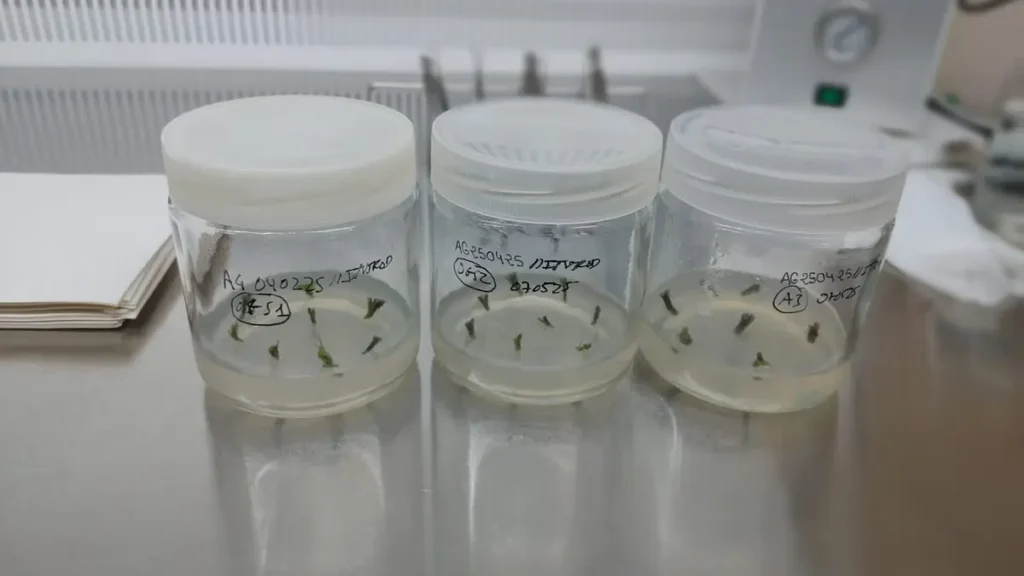
Most facilities that take hop latent viroid seriously still spread it with the bottle sitting on the propagation bench. Seventy per cent ethanol is the default disinfectant in horticulture, it is cheap, it evaporates cleanly, and against HLVd it does close to nothing. This is worth twenty minutes of your attention, because it is the cheapest correction available to a cannabis facility and almost nobody has made it.
Why the usual products fail
HLVd is not a bacterium and not a conventional virus. It is a naked circular RNA of 256 nucleotides with no protein coat and no lipid envelope. Almost everything a standard disinfectant attacks is absent. Ethanol works by denaturing proteins and disrupting membranes, which is why it is effective against bacteria and enveloped viruses, and why it leaves an unprotected RNA molecule essentially intact.
The published work is blunt about how tough the molecule is. Infectious viroid has been recovered from crushed sap after seven days, and from dried leaf and root tissue after four weeks. It survived thirty minutes at 70 to 90 °C and remained amplifiable. It tolerated UV-C exposure. A pathogen that shrugs off half an hour near boiling is not going to be troubled by a wipe of alcohol.
Tested and found ineffective against HLVd: seventy per cent ethanol, hydrogen peroxide, and two per cent Virkon. If your standard operating procedure names any of those as the viroid control step, that step is decorative.
What works
Sodium hypochlorite. Ordinary household bleach, diluted to five to ten per cent of the bottle, degrades the RNA itself rather than trying to disrupt a structure the viroid does not have.
In practice:
- Tools. Household bleach at five to ten per cent, one to two minutes of contact. Contact time is not optional. A quick dip is not a soak, and the difference between a two second dip and a ninety second soak is the difference between a protocol and a ritual.
- Blades, dry method. Dry heat at 160 °C for ten minutes. Useful where you do not want bleach residue on steel.
- Hard surfaces. Hypochlorous acid at around 1000 ppm, or the same bleach dilution, on benches, trays and tool rests.
- Two tools, alternating. One blade in the bleach while the other is in use gives you real contact time without slowing the work. This single change does more than any product substitution.
Bleach corrodes. Rinse tools in clean water after the soak and dry them, and accept that consumable blades are consumable. The arithmetic is not close: a box of blades costs less than one infected cycle.
The places nobody disinfects
Tools are the obvious route and the one everyone thinks about. The viroid has also been recovered from nutrient solution, irrigation nozzles, watering cans, bench surfaces and grinding pestles. It spreads root to root through recirculating irrigation, and did so within two weeks in a controlled trial.
So the list of things that need a hygiene decision is longer than the list of things that touch a blade:
- Irrigation tanks, lines and nozzles, especially anything recirculating
- Watering cans and hoses moved between rooms
- Propagation benches, trays and the surface where cuttings are laid down while you work
- Gloves, which are cheaper to replace per plant than to disinfect
- Any lab equipment used to homogenise tissue for sampling
Quarantine and production should not share a recirculating solution. If they do, the quarantine is a formality.
The cut itself matters
One finding from the same body of work deserves its own paragraph, because it costs nothing to apply. Transmission through wounds depends on how the wound is made. Tearing and abrasion transmitted the viroid. Clean cuts with a sharp blade often did not.
Sharp tools, one clean cut, no twisting the stem off. Handle plants without crushing petioles. Work clean to dirty, from your youngest and most valuable material towards the material you already suspect, never the other way round.
A protocol you can put on the wall
- Two blades per worker, alternating, five to ten per cent bleach, minimum one minute in the soak.
- Fresh bleach solution every session. Hypochlorite degrades in light and in air.
- One pair of gloves per plant group, or per plant when handling mothers.
- Sharp blades. Cut, do not tear.
- Benches and trays wiped with the same dilution between groups.
- Quarantine on its own irrigation, never recirculating into production.
- Clean to dirty, always, and never back.
- Bin the ethanol spray as your viroid step. Keep it for what it is good at.
Where this does not help
Clean tools stop you from moving the viroid between plants. They do nothing about material that arrived already infected, and nothing about a mother plant carrying it silently. HLVd is asymptomatic through rooting and vegetative growth, and only announces itself under flowering, which is why a mother room can look healthy for months while every cutting it produces is already positive.
Hygiene is the second half of the problem. The first half is starting from tested material and testing again after quarantine.
Sources: Punja et al., “Epidemiology and management of hop latent viroid in cannabis”, Plants 14:830, 2025. Oregon State University Extension, EM 9570, “Hop latent viroid in hemp”, 2024. Pacific Northwest Plant Disease Management Handbook, viroid diseases of hemp, revised 2026.